Learn
Articles & Guides

Can a Cash-Out Refinance be Used to Pay Off Credit Card Debt?
Summary
A cash-out refinance lets you tap into your home equity to pay off high-interest debt, potentially replacing multiple monthly payments with one lower mortgage payment. It can be a smart financial move, but only if the interest rate gap is significant, the break-even math works for your timeline, and you're honest about the trade-offs involved.
If you're a homeowner juggling multiple debt payments, you know how quickly interest charges can make it feel like your money is disappearing into a void. What many homeowners like you don't realize is that the equity you've built up in your home could be used as a tool to help you pay off credit card debt.
A cash-out refinance lets you tap into that equity, replace your current mortgage with a new one, and use the difference to eliminate high-interest debt, potentially rolling everything into one lower monthly payment. This guide breaks down how a cash-out refinance can be used to pay off credit card debt and some important factors to consider before deciding to refianance.
How Does a Cash-Out Refinance Work for Credit Card Debt?
A cash-out refinance replaces your existing mortgage with a new, larger one, and the difference between the two comes to you as a lump sum of cash at closing. You can then use that cash to pay off high-interest balances immediately, leaving you with a single monthly mortgage payment in place of the multiple bills that were draining your budget.
What makes this strategy worth exploring for debt consolidation is the interest rate gap. Credit cards routinely carry interest rates of 20% or higher while mortgage rates, even in a higher rate environment, typically sit well below that. This presents the perfect opportunity for homeowners to consider a cash-out refinance.
Crunch the numbers with our mortgage refinance calculator.
Benefits of Consolidating Debt
Paying off multiple loans and high-interest debt can help you streamline your monthly payments and provide multiple benefits.
- Interest Saving: Mortgage interest rates are typically lower than interest rates on other types of debt, such as credit cards and personal loans, meaning you can save on interest.
- Reduced Monthly Payments: If you have a lot of high-interest debt, your monthly payments may be very high. You can potentially reduce your monthly payments and make it easier to start saving monthly.
- Simplified Budget: Managing multiple debts with different rates and due dates, can be stressful. By consolidating your debt into one loan, you can simplify your budget and stay on track.
- Improved Credit Score: When you pay off debt, your credit score can improve. This can make it easier to get approved for loans and other forms of credit in the future.
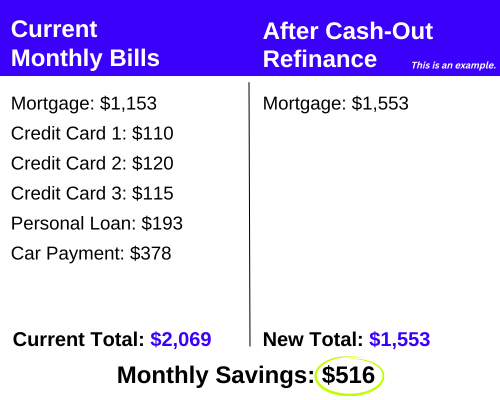
Here is a simple example of how you can use the cash you receive to pay off multiple debts, simplify payments, and lower your overall monthly bills.
Where Does Your Home Equity Come In?
The amount of money you can receive with a cash-out refinance varies and is dependent on the amount equity that has been built up in your home. Home equity is the difference between what is owed on the mortgage and what the home is currently worth. For example, if you owe $100,000 on your mortgage and your home is worth $350,000, this means you have $250,000 of home equity.
Two ways home equity can grow are:
-
The amount of equity in your home will rise as you pay down your mortgage and
-
The amount of equity will increase if the value of your home goes up
Explore additional advantages of a cash-out refinance.
Factors to Consider When Deciding if You Should Use Cash-Out Refinance for Credit Card Debt
The hardest part of any financial decision is figuring out if it makes sense for you. The best way to do that is to take all contributing factors into consideration and consult with a mortgage lender. Before reaching out, it may be helpful to pull some numbers and take a look at the following factors so that you have a baseline understanding of your financial situation.
The Interest Rate Gap
The bigger the difference between your mortgage rate and your credit card APRs, the stronger the case for consolidating. If your current mortgage rate is already high (say, close to or above current market rates) the benefit shrinks because you're not gaining as much on the interest rate differential. The refinance needs to get you into a rate low enough to make it worth your while.
Your Current Mortgage Rate
This is one of the most overlooked factors. If you bought or last refinanced when rates were low (say, 3% or under) refinancing into today's rate environment means your entire mortgage balance moves to a higher rate, not just the cash-out portion. That can significantly offset or even eliminate the savings from consolidating the credit card debt. The size of your existing mortgage relative to the debt you're paying off matters a lot here.
How Much Debt You're Consolidating
A cash-out refinance comes with closing costs typically ranging from 2% to 5% of the loan amount. If you're only consolidating a small amount of high-interest debt, those closing costs can outweigh the interest savings relatively quickly. Generally speaking, the larger the high-interest debt balance, the stronger the case for refinancing.
Your Home Equity Position
Most lenders require you to maintain at least 20% equity in your home after the cash-out. If you don't have sufficient equity built up, you may not qualify for enough cash to make a meaningful difference, or you may not qualify at all.
Your Credit Score
Your credit score directly affects the rate you'll be offered on the new mortgage. A lower rate strengthens the case for refinancing, while a higher rate weakens it. It's worth knowing where your credit stands before running any numbers, because the rate you qualify for changes the entire calculation.
How Long You Plan to Stay in the Home
The break-even point is the number of months it takes for your monthly savings to recoup the closing costs. This is only relevant if you're still in the home when you reach it. If there's a chance you'll sell in the next two to three years, the closing costs may not have time to pay for themselves.
The Spending Habits Behind the Debt
This is less about math and more about self-awareness. If the credit card balances were built up gradually through everyday spending rather than a specific one-time event, consolidating the debt without changing the habits that created it is a significant risk. Paying off the cards only to run them back up while carrying a larger mortgage is a worse outcome than the original problem.
The Repayment Timeline
Rolling a credit card balance you might have paid off in two or three years into a 30-year mortgage extends that debt significantly, even if the monthly payment is lower. For smaller balances or debt that's close to being paid off, this trade-off can outweigh the interest savings.
Tax Implications
It's worth consulting a tax professional, but it's important to know that the interest on cash-out refinance funds used for debt consolidation is generally not tax deductible the way mortgage interest on home purchase or improvement loans can be. This doesn't change the math dramatically for most borrowers, but it's a factor worth being aware of.
Is a Cash-Out Refinance Right for You?
A cash-out refinance isn't a magic solution, but for the right homeowner, it can be one of the most effective tools available for breaking the cycle of high-interest debt. What it requires is an honest look at the full picture which includes your equity position, your credit profile, your timeline in the home, your spending habits, and whether the break-even math makes sense for your situation. If those pieces all align, it’s absolutely worth pursuing.
Before you start the application process, we encourage you to have a conversation with an expert. Our loan officers can take your actual numbers, walk you through exactly what a cash-out refinance would look like for your home and your debt, and give you an honest assessment of whether it makes sense.
Talk to an Onity Loan Officer today and find out what your equity could do for you. Contact us online or give us a call at 1-877-319-0577
Any equity cashed out in refinance will increase the mortgage balance owed on the property. Rates are not guaranteed and based on the applicant’s credit history at the time of application.
Key Takeaways
- The larger the gap between your mortgage rate and your credit card APRs, the stronger the case for a cash-out refinance.
- If you're currently in a low-rate mortgage, refinancing moves your entire balance to a new rate — not just the cash-out portion. Factor this in before moving forward.
- Closing costs typically run 2% to 5% of the loan amount and affect how long it takes to break even. Divide your closing costs by your monthly savings to find that number.
- Rolling unsecured debt into your mortgage means your home is now on the line for debt that previously wasn't secured by it.
- Monthly savings alone don't tell the full story. Total interest paid over time and the extended repayment timeline matter just as much.
- Consolidating debt without addressing the spending habits that created it is one of the biggest risks of this strategy.
- An Onity Mortgage Loan Officer can apply all of these factors to your specific situation and give you a clear picture of whether this move makes sense for you.
Cash-Out Refinance FAQs
The cash from a cash-out refinance is yours to use as you see fit. That said, if debt consolidation is your goal, it's generally a good idea to prioritize your highest-interest balances first to maximize your savings. Having a clear plan for exactly which accounts you'll pay off before closing helps you request the right amount and avoid borrowing more than you need.
No — paying off a credit card balance doesn't automatically close the account. The accounts remain open with a zero balance, which can actually have a positive short-term effect on your credit score by improving your credit utilization ratio. The important thing is to be intentional about how you use those accounts going forward, since running the balances back up is one of the key risks of debt consolidation.
Mortgage interest is generally tax deductible when the funds are used to buy, build, or substantially improve your home. When cash-out funds are used for debt consolidation, that interest is typically not deductible in the same way. This doesn't dramatically change the math for most borrowers, but it's worth discussing with a tax professional before moving forward so you have a complete picture of the financial impact.
Your available equity is based on your home's current appraised value, not what you paid for it. If your home has decreased in value, your equity position may be smaller than you expect, which could limit how much cash you can access or affect whether you qualify at all. Most lenders require you to retain at least 20% equity after the cash-out, so a lower home value tightens that calculation. An Onity Loan Officer can help you get a realistic picture of where you stand before you go through a full appraisal.
For a primary residence, there is a three-business-day rescission period after closing during which you have the right to cancel the transaction. Once that window passes, the funds are disbursed, typically within one to two business days. Your Onity Loan Officer can walk you through the exact timeline for your transaction so you can plan accordingly.